
Trapped Key Safety Systems Selection Guide
Compare trapped-key access sequence with alternative safeguarding arrangement. Use the same application conditions and record what each proposal includes, excludes or still needs to prove.
Validate all access and energy conditions, personal control, escape and lost-key management. Compare the required risk reduction and complete safety functions; access frequency alone cannot determine suitability.
For safeguarding existing machinery for trapped-key machinery access control, a short trial that reproduces the difficult condition is often more useful than a long list of nominal specifications.
Compare options in the conditions where they must work — Trapped Key Safety Systems
Plan trapped key safety systems around your machine hazards, operator tasks, access, stopping behaviour and validation evidence. Discuss a site-specific safeguarding concept with Oxford Machine Guarding. A useful shortlist should show how every option copes with hazards and foreseeable access for trapped-key machinery access control and space, visibility and operator ergonomics.
Discuss your application
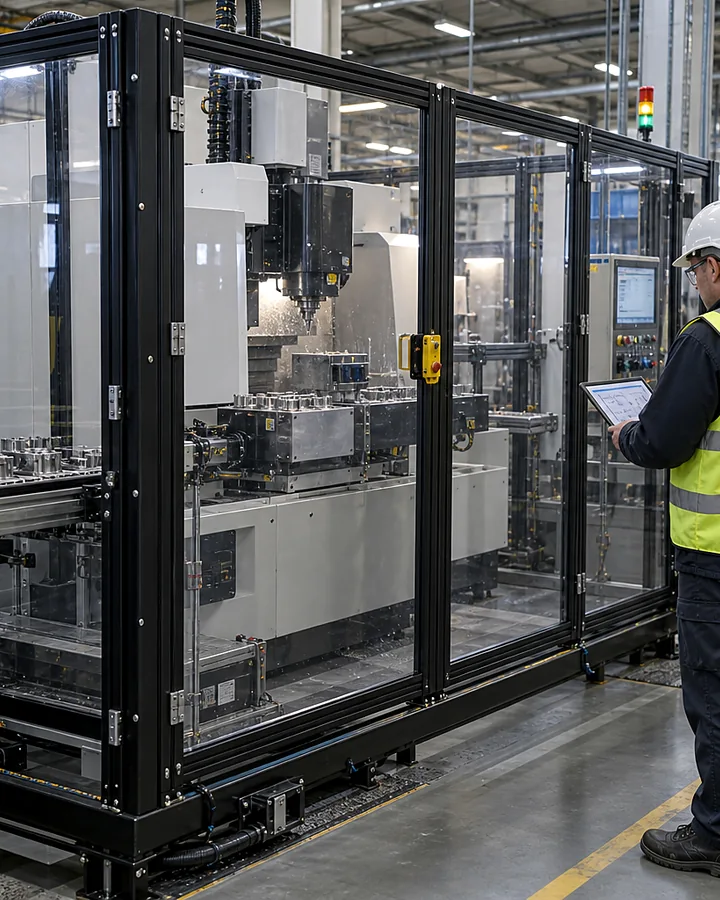
Ask every supplier the same questions
| Decision to resolve | Evidence to compare |
|---|---|
| What must be safe before a key is released? | Hazard and energy-source assessment. |
| Which access points and tasks are involved? | Access map and task list. |
| How are several people accounted for? | Single-person and multi-person access scenarios. |
| What is the key-exchange sequence? | Controlled key schedule and state diagram. |
| How are escape and restart handled? | Escape, area-check and deliberate-restart review. |
| What evidence is required at handover? | Safety-function validation and handover records. |
Include simpler approaches to trapped-key machinery access control in your shortlist
| Route to assess | When it belongs in the comparison | Deciding check |
|---|---|---|
| Trapped-key access sequence | The machine-specific assessment supports a defined exchange of keys controlling isolation, entry and return to service. | Validate all access and energy conditions, personal control, escape and lost-key management. |
| Alternative safeguarding arrangement | The assessed tasks or hazards require another physical or monitored access strategy. | Compare the required risk reduction and complete safety functions; access frequency alone cannot determine suitability. |
Pause before choosing when…
- Only perfect or hand-selected examples of safeguarding existing machinery for trapped-key machinery access control are available.
- No one has defined how risk-reduction and validation evidence will be evaluated.
- The normal range for hazards and foreseeable access for trapped-key machinery access control is described only as “usually fine” but has not been bounded.
- Your operator, cleaning, maintenance or recovery access has not been considered.
- Quoted performance depends on another machine or data source that is not included.